RESEARCH USE ONLY (RUO) PRODUCTS

Mixing, storage and dosing
Proper handling, mixing, and storage of peptides are essential to maintain their stability, potency, and effectiveness.
Most peptides are supplied as a delicate lyophilized (freeze-dried) powder, which helps preserve the compound during transport and storage. Because peptides are sensitive to heat, light, and moisture, they must be handled with care once opened.
Reconstitution (Mixing)
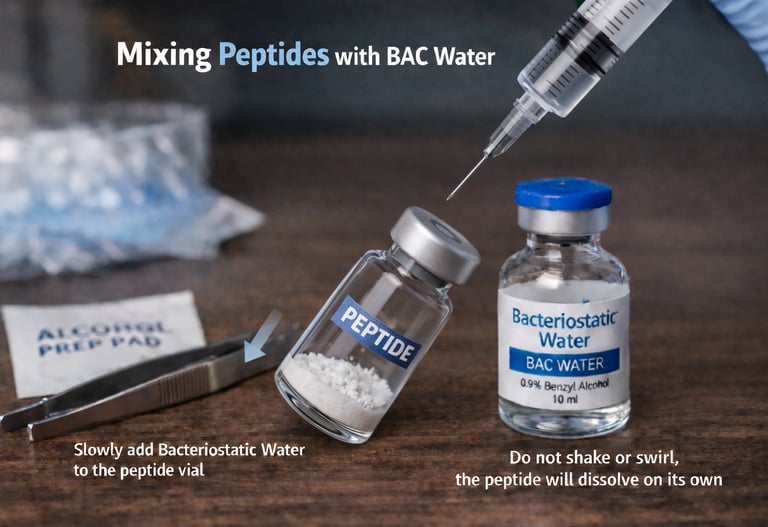
Before use, peptides must be reconstituted (mixed) with a sterile liquid. The most commonly used diluent is Bacteriostatic Water (BAC water), which contains 0.9% benzyl alcohol. This helps inhibit bacterial growth and allows the mixed solution to remain usable for approximately 28–30 days when stored correctly.
Preparation
Allow both the peptide vial and the BAC water to reach room temperature before mixing.
Clean Handling
Always use proper aseptic technique. Clean the rubber stoppers on both vials using an alcohol swab before inserting a needle.
Pressure Management
Many peptide vials are sealed under a light vacuum. When inserting the needle, the vacuum may naturally draw the water into the vial. In some cases, a small amount of air may need to be injected first to equalize pressure.
Mixing Method
Peptides should never be shaken, as vigorous agitation can damage the delicate peptide chains. Slowly allow the water to run down the inside wall of the vial. Once added, the water will completely dissolve the powder in a minute or two , never swirl or shake the vial.
Storage After Mixing
Once reconstituted, the peptide solution should be stored in a refrigerator (2–8 °C) and protected from light. For best stability and effectiveness, the solution should generally be used within 28-30 days.
Dosing
Peptide solutions are typically measured using a standard U-100 insulin syringe, which is marked from 0 to 100 units (IU). These markings represent volume, not the amount of peptide itself. In a U-100 syringe, 100 units equals 1 mL, so each unit represents 0.01 mL of liquid.
The actual amount of peptide in each syringe unit depends on how the vial was reconstituted (mixed) with bacteriostatic water. For example, if a peptide vial is mixed with 2 mL of bacteriostatic water, the total liquid volume becomes 2 mL, which equals 200 units on a standard insulin syringe.
This means the vial contains 200 measurable syringe units in total. If someone draws 20 units, that represents 0.2 mL of solution, resulting in 10 equal portions from a 2 mL vial.
Because peptides vary widely in concentration and intended use, the correct amount depends entirely on the specific compound and research protocol. Always calculate carefully based on the total peptide amount and the volume used during reconstitution.
This information is provided for general educational and research reference only. Products are intended for laboratory and research use, and sterile handling procedures should always be followed when preparing or measuring peptide solutions.